
Electric aircraft · October 2026
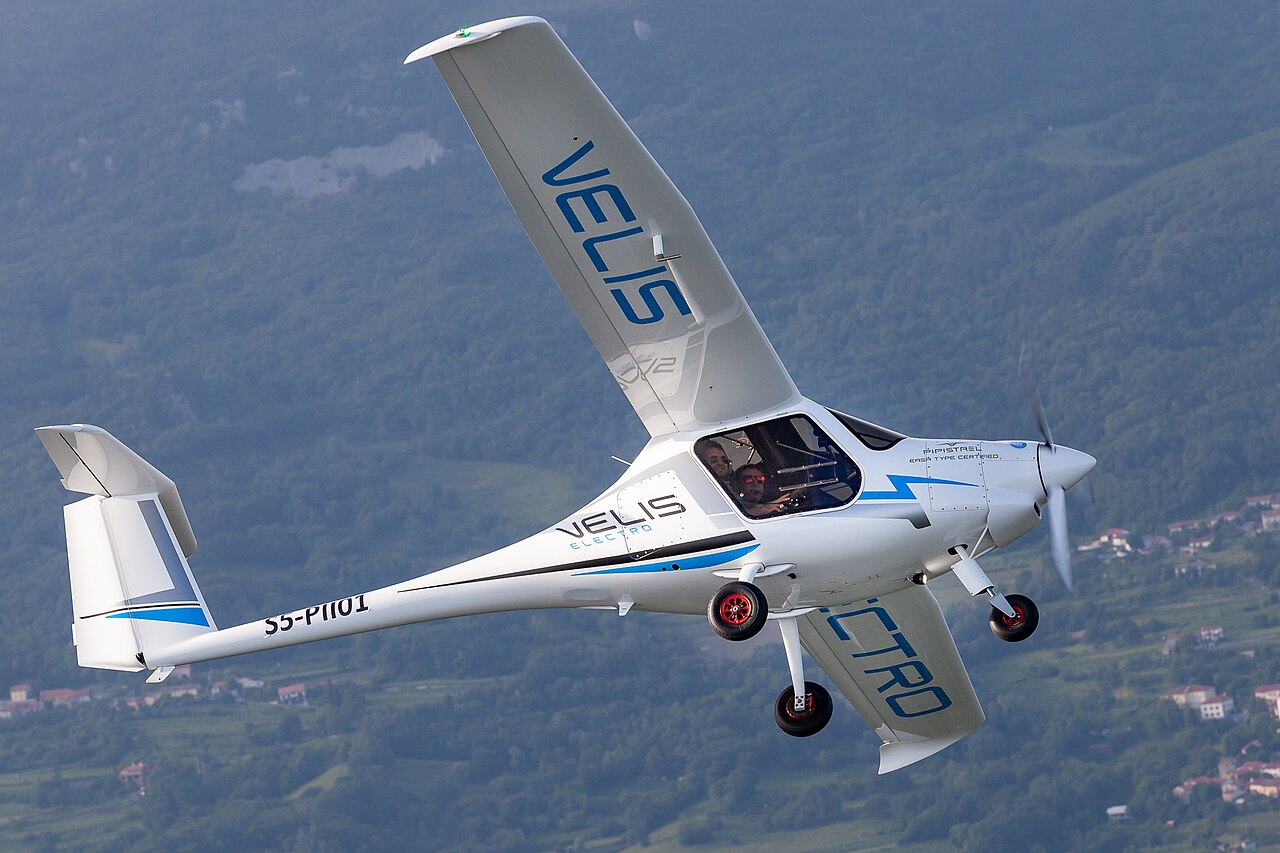
Pipistrel Velis Electro, S5-PII01, the first EASA type-certified electric aeroplane. Photo: Airjuice Photography, via Wikimedia Commons.
Electric aircraft are already flying in 2026, and they are no longer just drawings. They are also not a way to cross from Paris to Lagos. The useful question in October 2026 is narrower: which aircraft have a type certificate, which ones carry paying people, and which programmes are still flight-test stories with a commercial date attached.
Therefore, for a charter desk the answer is already clear enough to publish. Battery aircraft are in daily use where the hop is short and the payload is a student, or — in China — two sightseeing passengers who take off and land at the same site. They are not in use as business jets, medical evacuations across a continent, or regional airliners. The gap is energy, not ambition.
A short history of electric aircraft, without the folklore
People have hung electric motors on flying machines for a century. The first person-carrying electric aeroplane generally credited with a proper flight is the Militky MB-E1, a converted Brditschka HB-3, flown in Austria on 14 October 1973. It proved a point. It did not start an industry. The batteries of the time could not.
Solar demos and early prototypes
Afterwards, the modern public story starts with sunlight, not lithium. Solar Impulse, the single-seat aircraft of Bertrand Piccard and André Borschberg, flew around the world in stages between 2015 and 2016. HB-SIA, the first aircraft, had already shown that a solar aeroplane could stay aloft through the night. The circumnavigation was a demonstration of patience and weather, not a transport product. No airline was going to sell a seat on it.
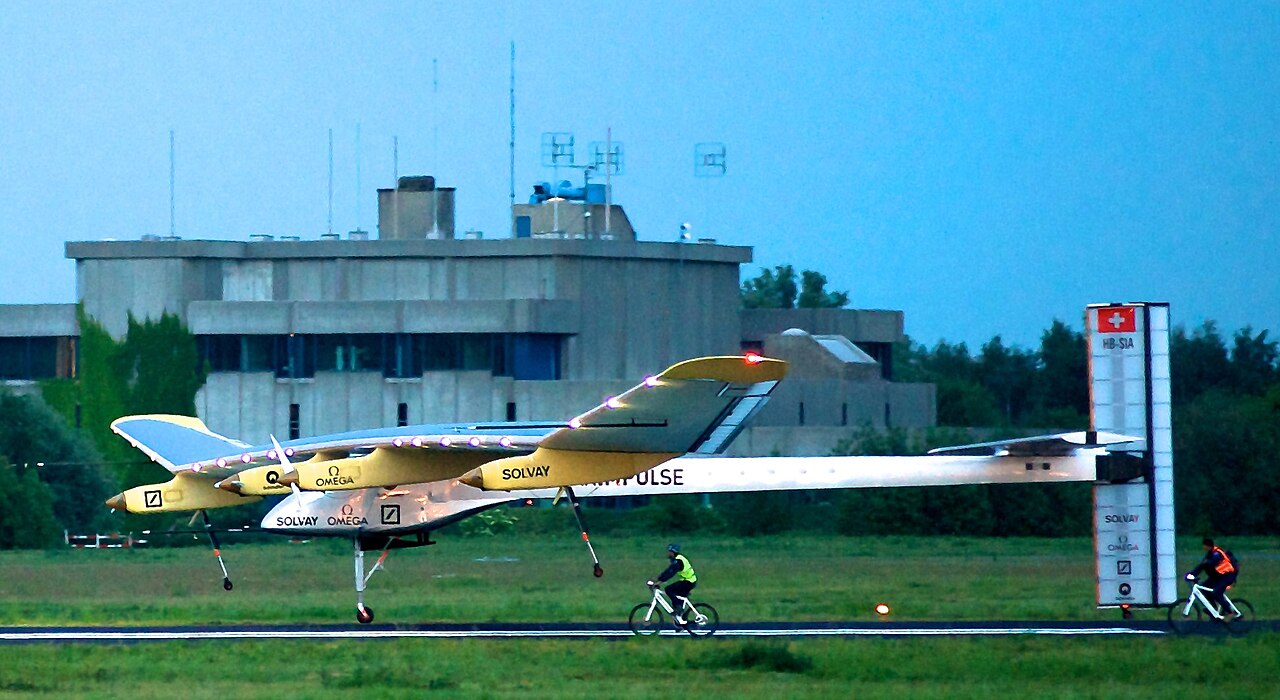
Solar Impulse HB-SIA on landing at Brussels. A demonstration aircraft, not a transport one. Photo via Wikimedia Commons.
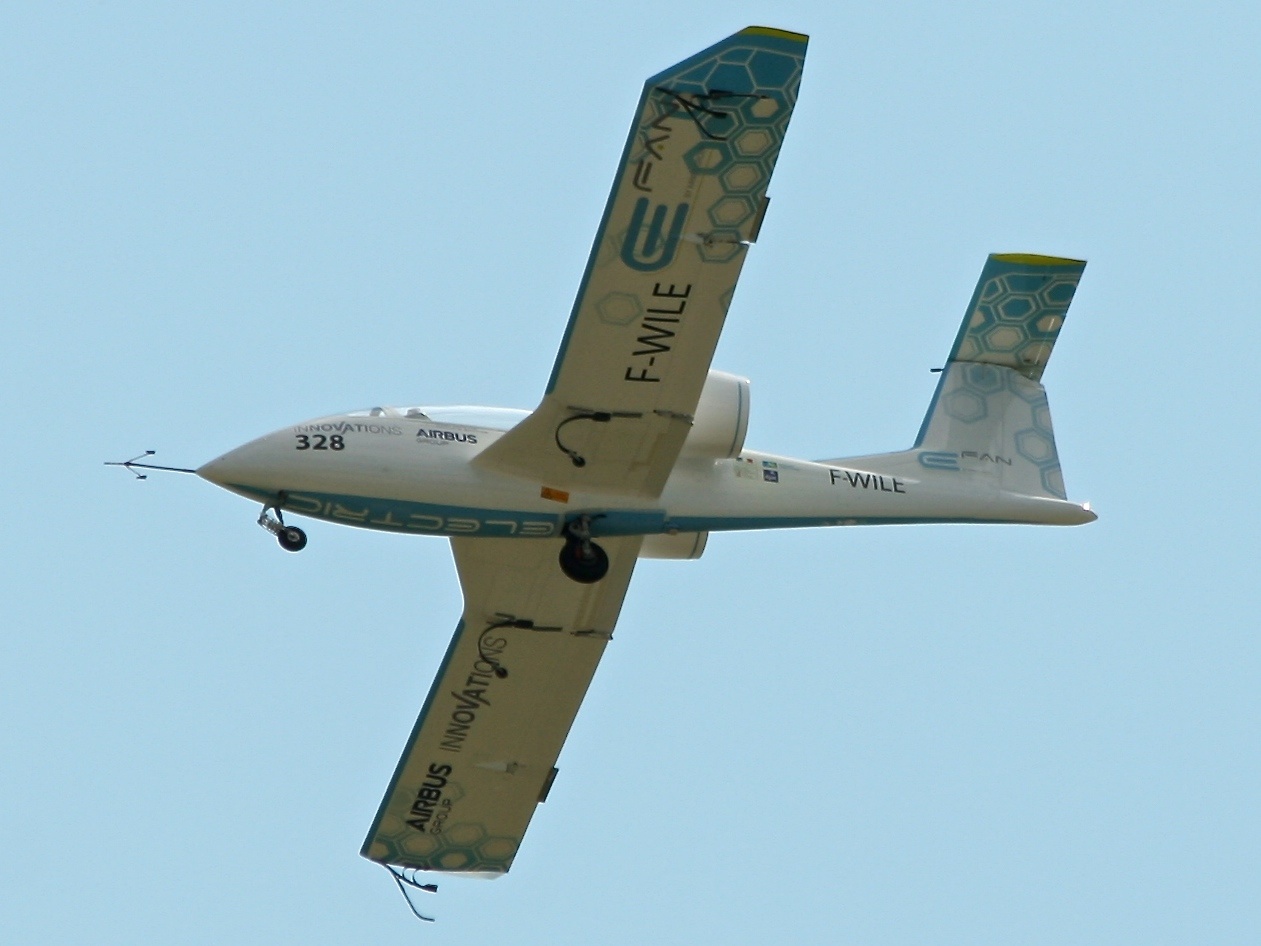
Airbus E-Fan, the two-seat prototype flown in the middle of the last decade. Photo via Wikimedia Commons (Creative Commons).
Airbus picked up the thread with the E-Fan, a two-seat electric prototype that flew in 2014 and crossed the English Channel in 2015. The follow-on E-Fan X, a hybrid BAe 146 testbed with Rolls-Royce and Siemens, was cancelled in 2020. The lesson travelled further than the aircraft: a technology programme is not a fleet plan.
The first certified electric trainer
Next, the first electric aeroplane a flying school can actually buy arrived in June 2020. The Pipistrel Velis Electro, a two-seat derivative of the Virus, received EASA type certificate EASA.A.573. It was the first type-certified electric aeroplane. The UK CAA followed. An FAA light-sport path came later, and Transport Canada validated the type certificate in November 2025. Textron has owned Pipistrel since 2022 and has kept the line in production under Textron eAviation.
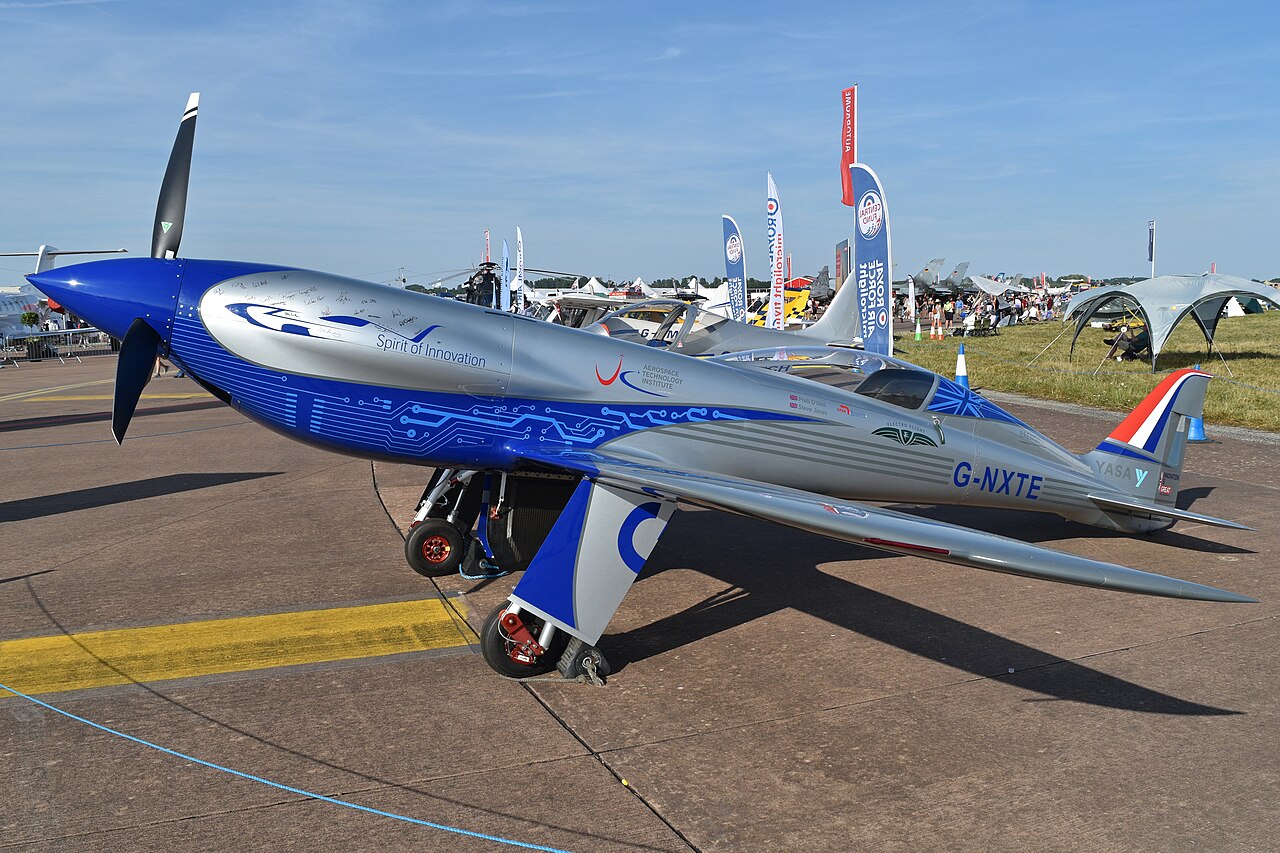
Spirit of Innovation, the Rolls-Royce ACCEL record aircraft, G-NXTE. Photo via Wikimedia Commons (Creative Commons).
A year later the Rolls-Royce ACCEL project, the Spirit of Innovation, set a class speed mark. In November 2021 the aircraft, registered G-NXTE, recorded about 555 km/h over a measured distance. Useful as a data point on motors and power electronics. Irrelevant as a charter aeroplane: one seat, minutes of endurance, no cabin.
What electric aircraft can and cannot do in 2026
Batteries set the range
An electric motor is a better machine than a piston engine for the job it is given. It is quieter, it has fewer moving parts, and a well-run training circuit feels the difference in fuel bills and in the neighbours. The limit is the battery. Jet-A holds on the order of forty times more energy per kilogram than today’s lithium-ion packs. That ratio, not the press release, sets the range.
On a Velis Electro the practical lesson is about fifty minutes of flight and a daytime VFR licence syllabus, not a tour of the Mediterranean. Charging, battery temperature and reserve rules decide how many trips a day the aircraft can fly. Harbour Air, in Vancouver, has lived this in public. Its magniX-powered DHC-2 eBeaver first flew off the Fraser River on 10 December 2019 and made a point-to-point test from Vancouver to Victoria harbour on 18 August 2022, about 45 minutes. By mid-2025 the programme had roughly 100 flight hours, and battery cooling still limited the test aircraft to about two flights a day, against the eight to ten revenue trips a piston Beaver flies. Transport Canada supplemental type approval was being discussed for 2026–27. It is not a commercial electric seaplane service.
Runway electric aircraft versus eVTOL
Meanwhile, two technical paths are being sold as if they were one product. A conventional electric aeroplane uses a runway, a known certification basis, and a charger at an airport that already exists. An eVTOL — electric vertical take-off and landing — adds a powered-lift problem, a new pilot qualification, and a vertiport that most cities do not have. The first path is slower to photograph and faster to certificate. Beta Technologies has bet on it with the ALIA CX300, a runway aircraft aimed first at cargo, with a vertical-lift variant behind it. Certification was still in progress in 2026, with a target around the end of the year or early 2027. Company figures put useful range in the low hundreds of nautical miles. That is a regional hop, not an ocean.
Hybrid programmes after the battery demo
However, hybrid is the concession the industry is making in public. Heart Aerospace flew its full-scale battery demonstrator, the X1, from Plattsburgh, New York, on 12 August 2026: 27 minutes, a little over 300 metres above the ground, more than a megawatt drawn from the batteries. It was the largest battery-electric aircraft flown to that date. Weeks later Heart set aside the 30-seat ES-30 as the commercial product and pointed at a 36-seat hybrid, the ES-36, with an all-electric range advertised around 200 km and a hybrid range around 1,200 km. First flight of a pre-production ES-36 is talked about for the second half of 2028. Entry into service is a 2030s question. JSX has put a deposit behind 50 aircraft. A deposit is not a schedule.
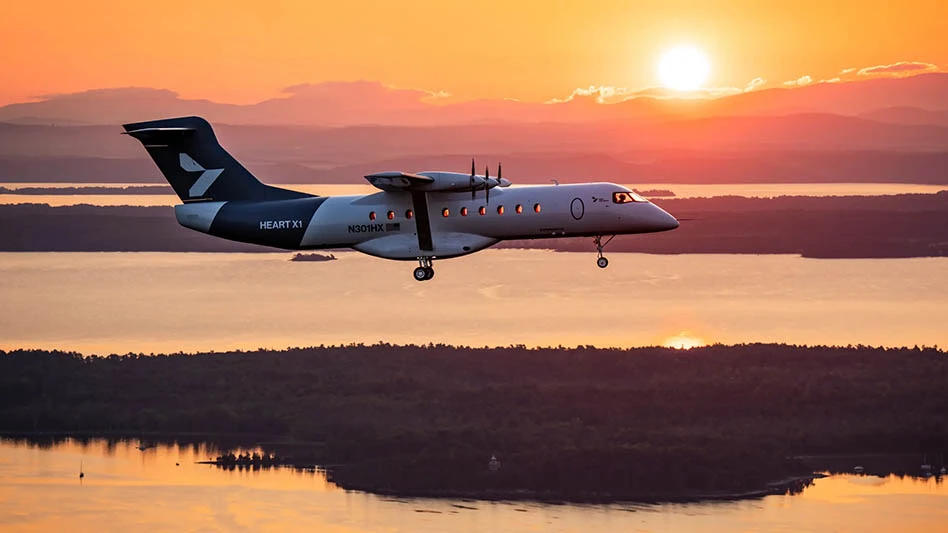
Heart X1, N301HX, on the 12 August 2026 first flight near Plattsburgh, New York. Demonstrator, not the aircraft that would enter service. Photo: Heart Aerospace.
Who is actually carrying people on electric aircraft in 2026
Strip the category back to paying passengers and the list is short.
Trainers already on the line
In addition, the Velis Electro is in commercial use, in the narrow sense that matters to a regulator: approved flying schools use it for paid ab-initio training, day VFR. Green Flight Academy in Sweden, Saxon Air in the United Kingdom and a scatter of European schools have put it on the line. It is a trainer. It is not an air taxi.
EHang sightseeing under a Chinese certificate
Still, the only passenger-carrying electric aircraft with a full commercial stack — type certificate, production certificate, airworthiness and an air operator certificate — is the EHang EH216-S, and the stack is Chinese. China’s regulator, the CAAC, issued the type certificate in October 2023, a production certificate in 2024, and the first operator certificates in March 2025, to Guangdong EHang General Aviation and Hefei Heyi Aviation. For now, the authorisation covers human-carrying sightseeing that takes off and lands at the same site. The aircraft is autonomous and seats two. EHang has reported more than 90,000 cumulative EH216-S flights by May 2026, more than 40 sites in China, and demonstration flights in other countries. Those demonstrations are not an EASA or FAA certificate. A Menkor client cannot book one in Paris, Dubai or Lagos.
Western air taxis still without tickets
By contrast, Western air-taxi programmes are further on than they were, and they are not open for tickets. Joby’s aircraft was in the last stage of FAA type certification in 2026, with a conforming aircraft in flight test and a Dubai arrangement with the Roads and Transport Authority often described as the first commercial theatre. Archer’s Midnight had its means of compliance accepted by the FAA, a Part 135 application filed in May 2026, and a restricted-type-certificate path in Abu Dhabi. Industry trackers in the third quarter of 2026 still placed a first US commercial ticket, if the certificates landed, in late 2026 or after — and several serious briefings still put routine passenger service in 2028. As of the first week of October 2026, neither company was running a scheduled city service a client could buy.
The cautionary file is Eviation’s Alice, a nine-passenger electric design with a thick order book on paper. It made one short flight in September 2022. In February 2025 the company paused the programme and cut staff while it looked for new money. Letters of intent do not keep a battery aircraft in flight test.
What electric aircraft mean for charter in 2026
None of this changes a private jet cost quote for a Falcon, a Challenger or a Global. The missions Menkor flies — Europe to West Africa, Dubai to Johannesburg, an air ambulance medical evacuation with a stretcher and a doctor — sit far outside the energy budget of a 2026 battery. An electric business jet is not a hidden option on the estimator. Anyone offering one is selling a rendering.
The places electric flying will show up first, if it shows up in this market at all, are dull on purpose. Island and harbour hops of under half an hour, once cooling and reserves allow a full duty day. Cargo and spare-parts flights into a short runway. Training, which has already started. For short one-way turbine trips today, empty legs remain the desk product clients can actually buy. A hybrid regional aircraft in the 2030s could matter to a group that today charters a turboprop for a 400 km trip. It will not matter to a board meeting in Libreville.
Regulation will move slower than the prototypes, and that is the correct order. EASA and the FAA still have to finish powered-lift rules, pilot ratings and vertiport standards before an eVTOL is a transport service rather than a demonstration. China’s certificate does not travel. A restricted certificate in Abu Dhabi is a start, not a network.
The prospect, stated plainly
In short, electric aircraft are a real way of flying in 2026. They are a small one. The certified, repeating operation is a two-seat trainer in Europe, plus autonomous sightseeing hops in China under a domestic certificate. Everything that looks like an airliner or a business jet is in flight test, in a hybrid redraw, or paused.
Over the next decade the plausible gains are short, frequent and infrastructure-light: training fleets, harbour and island routes, cargo into places that already have a runway and a charger. Hybrid range extenders are the honest bridge for anything over 200 km with reserves and a useful payload. Vertical air taxis may earn a city pair in the Gulf or the United States before they earn a timetable.
Finally, for a charter client the practical conclusion is the same one a desk should already be giving. Ask for the aircraft that can make the runway, the range and the medical or corporate day. In 2026 that aircraft has a turbine. Electric flight is worth watching. It is not yet worth pricing.
Menkor Aviation charters turbine aircraft across Europe, Africa and the Gulf, and arranges air ambulance and cargo when the mission needs them. For a firm quote, the desk is on +33 6 63 39 37 93 and [email protected], 24 hours — or use the contact form.